Features
Everything below is in the program today. Where a number appears it is read from the source, not written down twice.
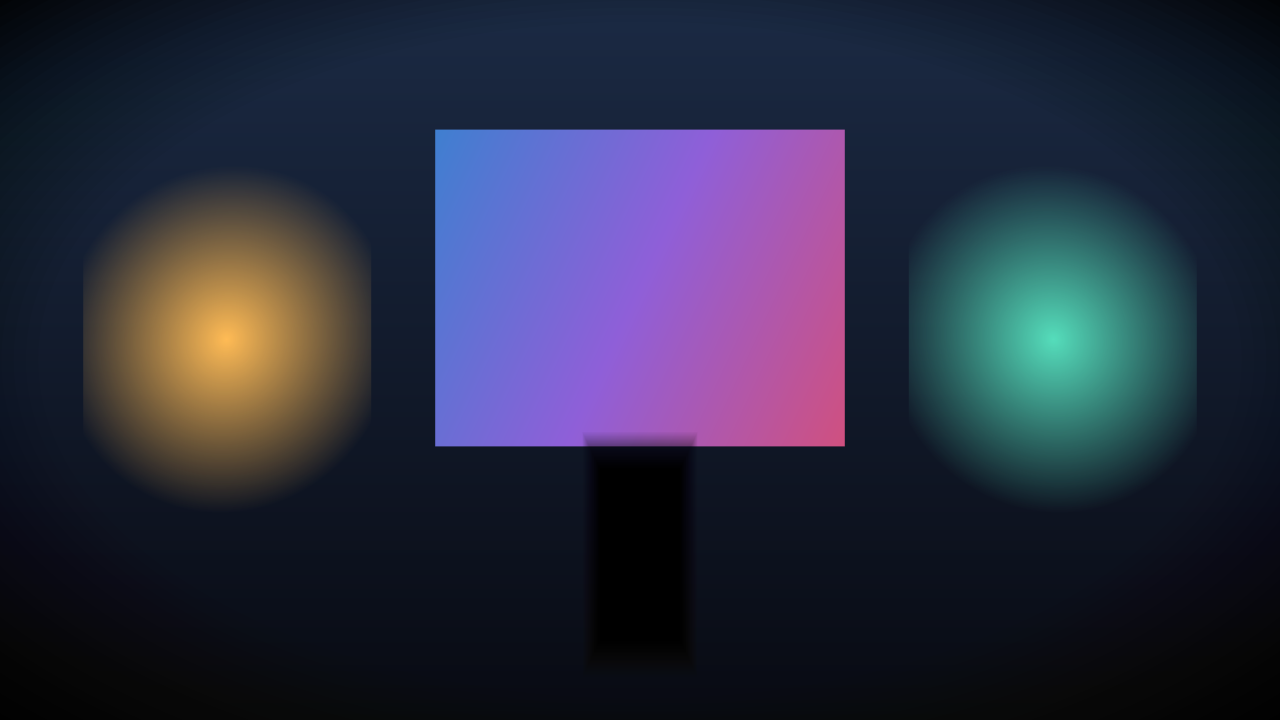
A scene is a stack of up to 32 objects: video, image, colour or gradient, and masks for blanking spill off things that should stay dark. Two of those have mesh-warping variants for surfaces that are not flat.
Objects have two modes: layout, with a grid and drag handles for placing them, and content, for what the object actually shows. Each can be softened at the edges with a vignette so it settles into the surface instead of ending on it.
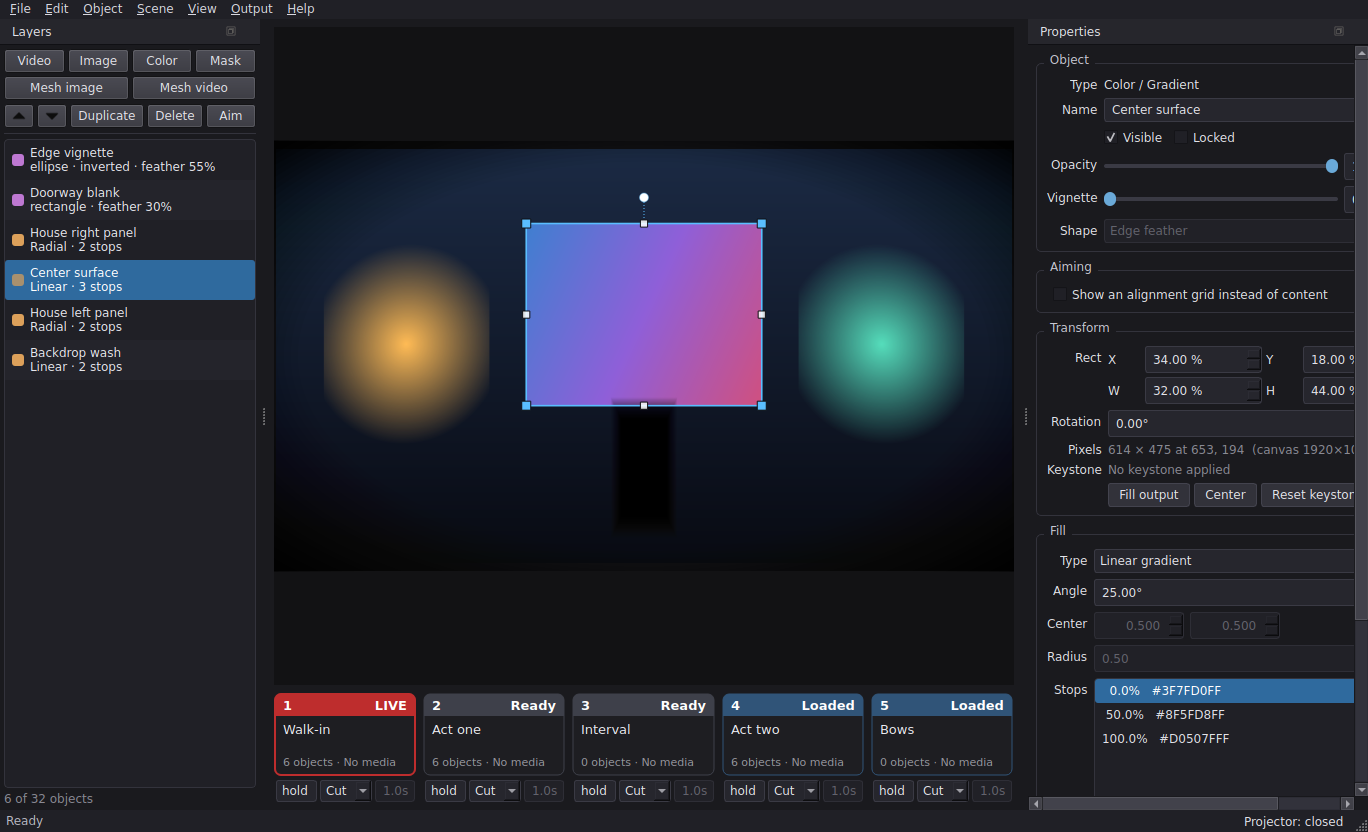
Each scene arrives with a cut or a cross-fade, with its own fade time, editable right on the scene strip.
Give each scene an active for time and the show advances itself, wrapping from the last scene to the first. A duration of zero means hold.
Fifty steps, per scene, covering everything that changes a scene - including edits made from the phone.
One folder for a show's images and video, with an Add from media list. A phone can put files in it too, if you allow it.

A borderless window fills the second screen. Pick which screen under Output, and flash the number on each one if you are not sure which physical projector is which.
Positions are stored as a share of the canvas rather than in pixels, so a show authored against a 1920×1080 projector still lines up on a 1280×800 one.
If nothing is live the output says so rather than going quietly black - that is how you tell an unassigned output from a dead one.
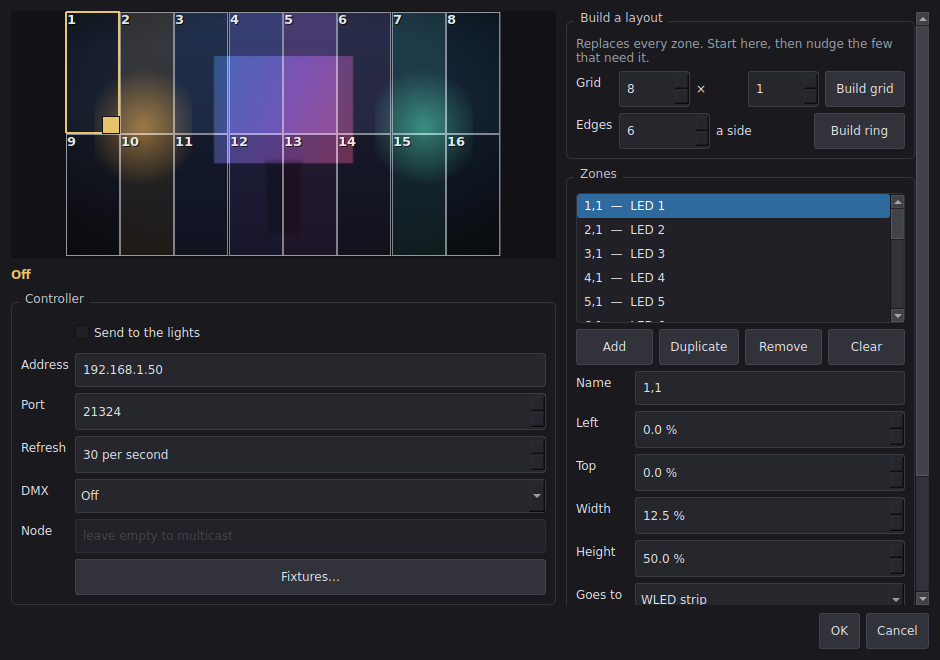
Rectangles of the canvas are averaged to a color every frame and sent to a WLED controller over the network, so LED strip, uplights or a backdrop wash change with the projection instead of being cued separately.
Zones are dragged over a live picture of the output, each one filled with the color it is sending, so what a lamp will do is visible before it is aimed. What they follow is the projector itself: they go out with a blackout and cross-fade with a dissolve.
Off by default. Every packet carries a two-second hold time, so a crash or a dropped network hands the rig back to its own programming rather than freezing it on the last frame that arrived.


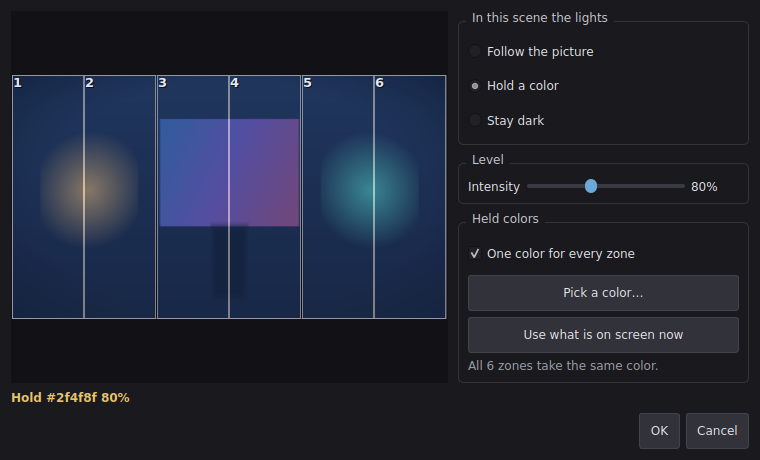
A scene can also tell the lamps what to do: follow the picture, hold a color, or stay dark, each with its own level. The cue arrives over that scene's own transition, so a three second fade moves the lights over three seconds too.
Cues travel in the scene file and zones stay with the machine - the same split a lighting desk makes between the cue and the patch - so a show plays in a venue whose rig is hung differently without a color being re-picked.
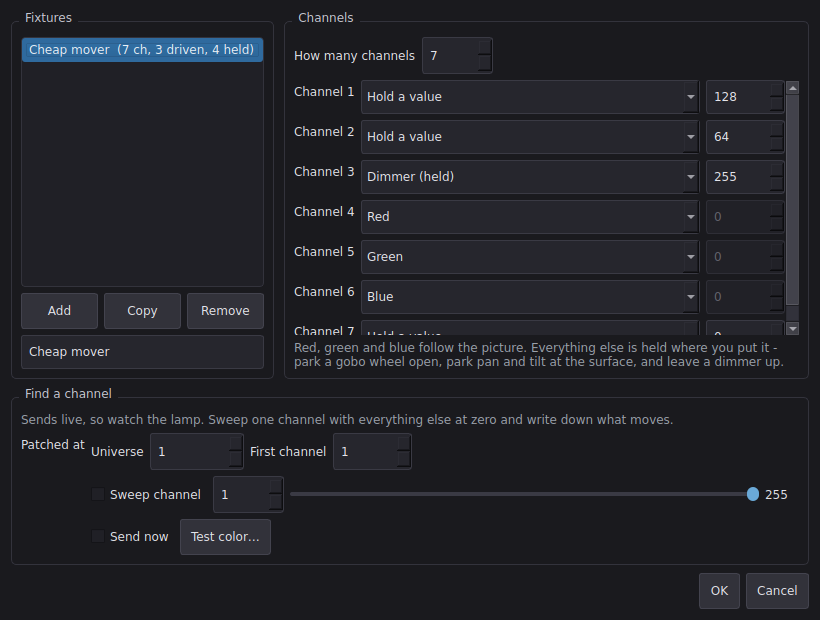
DMX fixtures work the same way: point a zone at a universe and a start channel instead of a run of LEDs, over Art-Net or sACN. Two generic RGB par profiles are built in - including the four-channel kind whose first channel is a dimmer, which is the one that catches people out.
For the lamps that arrive with a mode dial and no paperwork, the fixture builder finds out: sweep one channel with every other at zero, watch what moves, write it down. Red, green and blue follow the picture; every other channel is held where you park it.

Zones go out as pixels to a WLED controller, or as fixtures over Art-Net, sACN or an Enttec-compatible USB adapter, in one rig and on the same tick. A fixture builder describes anything not already known, including a channel sweep for lamps that arrive with no manual.
With the computer, not the show file - the zones describe where the lamps physically are, as a share of the canvas, so a rig survives a change of projector.
A scene can tell the lamps to follow, hold a color or stay dark, with its own intensity, and the cue arrives over that scene's transition. Patch with the machine, cue with the show - so a show plays anywhere without a color being re-picked.
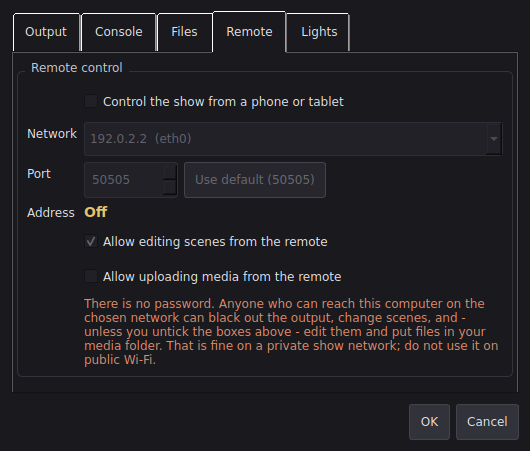
Output, console, files, remote and lights, in five tabs. The remote listens on port 50505 unless you change it, and the port does not move on its own, so a phone can bookmark the address.
Autosave keeps a recovery copy while anything is unsaved, at an interval you choose.

Stated plainly, because finding out on the night is worse.
No multi-projector edge blending.
Good for one 1080p video layer, not for 4K. The measurements are published.
Normal alpha compositing only - no additive or screen blending yet.
No timeline, cue list, MIDI or OSC. DMX is colour only: other channels are held where you park them.